

Blog


2026-08-14 16:17:50
When a precision component moves from a CAD drawing into production, choosing the right CNC Machining process can have a direct impact on accuracy, surface finish, production efficiency, and overall cost. Different components require different machining methods depending on their geometry, material, tolerance, and production volume.
For manufacturers and engineers, the goal is not simply to select the most advanced CNC machine available. The better approach is to choose a machining process that matches the actual requirements of the component.
The geometry of a component is one of the most important factors when selecting a CNC Machining process.
Simple plates, brackets, housings, and mounting components can often be manufactured efficiently using CNC Milling. These parts may only require operations such as facing, pocketing, drilling, tapping, and contour milling.
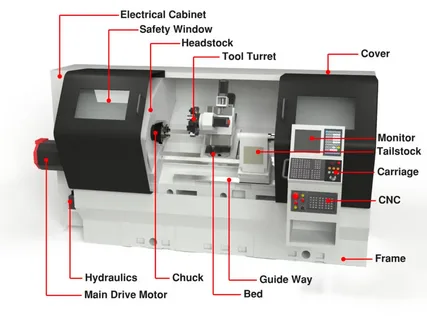
For cylindrical components such as shafts, pins, bushings, sleeves, and threaded parts, CNC turning is often more appropriate. If you are new to CNC manufacturing, understanding what is a CNC lathe can help clarify why turning is commonly used for rotational parts.
A CNC lathe holds the workpiece and rotates it while cutting tools remove material from the outside diameter, inside diameter, end faces, grooves, or threads. This makes CNC turning particularly effective for components where rotational symmetry is an important part of the design.
More complicated parts may require CNC milling, multi-axis machining, or a combination of different processes.
CNC milling and CNC turning are both widely used in precision manufacturing, but they work in fundamentally different ways.
In CNC milling, the cutting tool rotates while the workpiece is normally fixed. This process is suitable for producing flat surfaces, pockets, slots, holes, contours, and complex three-dimensional features.
In CNC turning, the workpiece rotates while the cutting tool moves against it. This makes the process especially suitable for cylindrical or round components.
Some components require both processes. For example, a shaft may first be turned to create accurate diameters and then milled to produce flats, keyways, holes, or other non-circular features.
Selecting the correct combination of machining processes can reduce unnecessary operations while maintaining dimensional accuracy.
As part geometry becomes more complicated, conventional three-axis machining may require multiple setups. Each additional setup can increase production time and introduce potential positioning errors.
Five-axis CNC machining provides additional rotational movement, allowing the cutting tool to approach a component from different directions. This is particularly useful for components with angled surfaces, complex contours, deep features, and difficult-to-reach areas.
The advantages of five-axis machining include fewer setups, better access to complex surfaces, improved surface quality, and more efficient machining of complicated geometries.
For a deeper explanation of how the technology works, see our article on What is a 5-Axis CNC Machine. It explains the five machining axes, different machine configurations, working principles, and common industrial applications.
The material of the component can significantly influence the machining strategy.
Aluminum is widely used for CNC machining because it is lightweight, relatively easy to machine, and suitable for many industrial and commercial applications. Stainless steel provides greater strength and corrosion resistance but generally requires more careful control of cutting parameters and tooling.
Copper, brass, titanium, engineering plastics, and other materials also have different machining characteristics.
Tool selection, cutting speed, feed rate, cooling, chip evacuation, and tool wear all need to be considered according to the material being processed.
A professional CNC machining supplier should therefore evaluate the material together with the part geometry rather than treating these factors separately.
Not every dimension on a CNC component needs the same level of precision.
Critical interfaces, bearing locations, mating surfaces, and functional dimensions may require tighter tolerances than general external surfaces. Applying unnecessarily tight tolerances to every feature can increase machining time, inspection requirements, and production costs.
Effective process planning identifies which dimensions are truly critical and allocates precision where it provides the most value.
Machine capability, workholding, cutting tools, programming, temperature control, and inspection equipment all contribute to final dimensional accuracy.
A machining strategy suitable for a prototype may not be ideal for mass production.
During the prototype stage, manufacturers need flexibility because engineers may make several design changes before finalizing the component. CNC machining is useful for rapid prototyping because parts can be produced directly from CAD data without the need for dedicated production tooling.
Once the design is finalized, production efficiency becomes increasingly important. Fixture design, tool life, cycle time, automated inspection, material utilization, and process repeatability can have a significant effect on the final unit cost.
For this reason, companies developing new products can benefit from working with a manufacturer capable of supporting both prototype development and production machining.
Surface finish should also be considered before machining begins.
Some parts can be used directly after CNC machining, while others may require polishing, anodizing, plating, powder coating, brushing, sandblasting, or other finishing processes.
The selected finishing method can affect dimensions and tolerances. For example, coatings may add material to a surface, while polishing can remove a small amount of material.
Planning machining and surface treatment together helps ensure that the final component meets its dimensional and functional requirements.
A CNC machine alone does not determine the quality of a finished component. Process planning plays an equally important role.
Engineers need to determine how the workpiece will be positioned, which tools will be used, how many setups are necessary, and which dimensions require additional inspection.
For complex components, reducing the number of setups can improve repeatability and reduce accumulated positioning errors. Proper workholding can also prevent vibration and movement during cutting.
Modern CNC manufacturing combines CAD/CAM programming, machining, inspection, and finishing into a controlled production workflow. This approach is particularly important when producing precision components with complex geometries.
When selecting a CNC machining supplier, buyers should consider more than the number of machines available.
A capable manufacturer should understand technical drawings, recommend suitable machining processes, work with different engineering materials, control dimensional tolerances, provide appropriate surface treatments, and maintain consistent quality throughout production.
It is also useful to consider prototype capabilities, production capacity, inspection equipment, lead times, and experience with similar components.
For projects involving complex geometries, multi-axis machining can provide additional flexibility. Understanding when to use CNC turning, CNC milling, or five-axis machining allows engineers to select a process that balances precision, efficiency, and cost.
Ultimately, the best CNC machining process depends on the specific component. By considering geometry, material, tolerance, surface finish, and production volume together, manufacturers can develop a more efficient path from prototype to finished part.