

Blog


2026-08-14 16:34:38
CNC Machining is widely used to manufacture precision components for automotive, electronics, medical equipment, industrial machinery, and other industries. Among the most common technologies are CNC turning and CNC milling. Although both use computer-controlled machining processes, they remove material in different ways and are designed for different types of components.
Understanding the difference between a CNC lathe and a cnc milling machine can help engineers select a more efficient manufacturing process before production begins.
A CNC lathe is a computer-controlled machine designed primarily for machining rotational components. During the machining process, the workpiece rotates around its central axis while a cutting tool moves along the programmed path.
This configuration makes CNC lathes particularly suitable for shafts, pins, bushings, sleeves, threaded components, and other round or cylindrical parts.
A CNC lathe can perform several operations, including external turning, internal boring, facing, grooving, threading, and drilling. Depending on the machine configuration, live tooling can also be used to produce additional features such as cross holes and milled surfaces.
For manufacturers producing large quantities of cylindrical components, CNC turning can provide excellent repeatability and efficient cycle times.
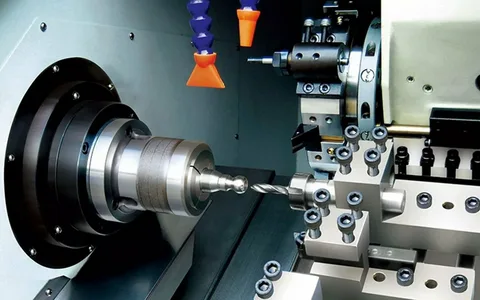
CNC milling works according to a different principle. Instead of primarily rotating the workpiece, the cutting tool rotates while the workpiece is held in a fixture.
This allows milling machines to produce a much wider variety of geometries, including pockets, slots, holes, flat surfaces, angled surfaces, contours, and complex three-dimensional features.
Three-axis CNC milling is sufficient for many conventional components. However, when a component contains multiple angled surfaces or difficult-to-reach features, additional axes can provide significant advantages.
Five-axis machining allows the cutting tool to approach the workpiece from multiple directions. This reduces the need for repeated repositioning and can make complex components easier to manufacture.
For a more detailed explanation of this technology, see our guide to What is a 5-Axis CNC Machine, which explains the basic structure, machining movements, advantages, and common applications of five-axis CNC Machining.
The geometry of the component should be the first consideration.
If most of the important features are arranged around a central axis, CNC turning is often an efficient choice. Shafts, spacers, threaded rods, bushings, connectors, and cylindrical housings are typical examples.
CNC turning is particularly effective when a component requires accurate diameters and concentric features. Because the workpiece continuously rotates during machining, manufacturers can efficiently produce consistent cylindrical surfaces.
Production volume is another consideration. Once the machining process and tooling are properly established, CNC lathes can produce large quantities of identical components with consistent dimensions.
CNC milling becomes more practical when the component has non-rotational geometry.
A rectangular housing with pockets and mounting holes, for example, would normally be more suitable for CNC milling than turning. The same applies to brackets, machine plates, structural components, and parts with complex contours.
Milling also provides greater flexibility for producing features on different surfaces. Depending on the machine configuration, the workpiece can be positioned or rotated so that different areas can be accessed during machining.
For components with particularly complex geometry, five-axis CNC machining can further reduce the number of setups required.
CNC turning and CNC milling are not competing technologies in every application. In many cases, they complement each other.
Consider a precision shaft with several stepped diameters, a threaded section, a cross hole, and a milled flat. The cylindrical portions can be produced efficiently on a CNC lathe, while the cross hole or flat may require milling.
Instead of forcing one machining method to perform every operation, manufacturers can combine turning and milling to achieve better efficiency and dimensional control.
Modern CNC production can also use mill-turn machines that integrate turning and milling functions into a single machine platform. This can reduce handling and improve production efficiency for complex components.
It is easy to assume that purchasing a high-end CNC machine automatically guarantees precision. In reality, final part accuracy depends on the entire manufacturing process.
Workholding, cutting tools, tool wear, programming, machine condition, material properties, temperature, and inspection methods can all influence the final result.
For tight-tolerance components, manufacturers need to establish appropriate inspection procedures and monitor critical dimensions throughout production.
The goal is not simply to achieve a high nominal machine accuracy, but to maintain stable and repeatable results from the first part to the last.
Different materials respond differently to cutting.
Aluminum is generally easy to machine and is commonly used for lightweight components and prototypes. Stainless steel offers excellent strength and corrosion resistance but can require more careful tool selection and cutting parameters.
Brass and copper have good machinability but also require attention to cutting conditions and surface quality. Titanium and other difficult-to-machine alloys can generate more heat and place greater demands on cutting tools.
Engineering plastics introduce another set of considerations because excessive cutting heat can cause deformation or dimensional changes.
A suitable machining strategy should therefore be developed around both the geometry and material of the part.
CNC machining is particularly useful during product development because the same basic manufacturing technology can be used from prototype production through low-volume manufacturing and, in suitable applications, larger production runs.
During prototyping, engineers can quickly evaluate dimensions, assembly relationships, functionality, and material performance. If a design needs to be modified, a new CNC program can be created without the need for a completely new mold.
For production parts, the focus shifts toward cycle time, fixture efficiency, tool life, repeatability, and cost control.
A manufacturer with experience in both prototype machining and production machining can therefore provide greater flexibility throughout the product development process.
Before requesting a CNC machining quotation, engineers should provide as much information as possible about the component.
The technical drawing should identify material, critical dimensions, tolerances, surface finish requirements, thread specifications, and any special treatments. Production quantity and expected future demand should also be considered.
For cylindrical parts, CNC turning may provide the most efficient solution. For parts with pockets, contours, and multiple flat surfaces, CNC milling may be more appropriate. Complex components with multiple orientations may benefit from five-axis machining or mill-turn technology.
The best process is ultimately the one that can achieve the required performance while maintaining reasonable production efficiency and cost.
CNC lathes and CNC milling machines serve different purposes, but both are essential technologies in modern precision manufacturing. CNC turning is highly effective for rotational components, while CNC milling provides greater flexibility for non-cylindrical and complex geometries.
For advanced components, multi-axis machining can further expand manufacturing capabilities by reducing setups and improving access to difficult surfaces.
By understanding the differences between CNC turning, CNC milling, and five-axis machining, engineers can make better manufacturing decisions and avoid unnecessary processing costs. The right machining strategy should always be based on the actual geometry, material, tolerance, surface requirements, and production volume of the component.