

Blog


2026-08-04 14:04:08
A 5-axis CNC machine is one of the most advanced machining systems used in modern manufacturing. Unlike conventional 3-axis machines that move only along the X, Y, and Z axes, a 5-axis CNC machine adds two rotational axes, allowing the cutting tool or workpiece to approach the material from multiple angles.
This additional flexibility enables manufacturers to produce highly complex components with fewer setups, higher accuracy, and improved surface finishes. As a result, 5-axis CNC Machining is widely used in industries such as aerospace, automotive, medical devices, mold manufacturing, and precision engineering.
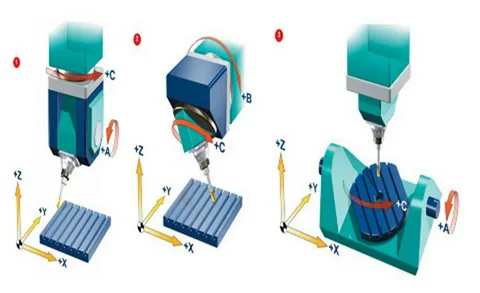
The term 5-axis refers to the five directions in which the machine can move or rotate during machining.
The three linear axes are:
X-axis: Left and right movement
Y-axis: Front and back movement
Z-axis: Up and down movement
The two additional rotary axes are typically:
A-axis: Rotation around the X-axis
B-axis: Rotation around the Y-axis
By combining these five movements, the machine can access multiple sides of a workpiece without repeatedly removing and repositioning it.
A 5-axis CNC machine operates through a combination of computer programming, precision motion control, and synchronized machining.
Engineers first create a 3D model using CAD software. CAM software then generates the machining paths required to manufacture the part.
The material is securely clamped to the machine table. Because the machine can reach multiple angles, most parts require only one setup.
During machining, the cutting tool and/or workpiece move simultaneously along five axes. This allows the machine to produce complex contours, deep cavities, and angled surfaces with exceptional precision.
The CNC controller continuously monitors the programmed tool path, ensuring accurate positioning, smooth motion, and consistent machining quality.
Fewer setups reduce positioning errors and help maintain tighter dimensional tolerances.
Multiple surfaces can be machined in a single setup, reducing machine downtime and increasing productivity.
The machine can create intricate geometries that are difficult or impossible to produce efficiently with a traditional 3-axis machine.
Maintaining the optimal cutting angle throughout the machining process improves surface quality and reduces the need for secondary finishing.
Optimized tool orientation reduces cutting forces and distributes wear more evenly, extending tool life in many machining applications.
Because of their flexibility and precision, 5-axis CNC machines are used in many industries.
Manufacturing turbine blades, engine components, and lightweight structural parts with complex geometries.
Producing engine components, transmission housings, prototypes, and precision mechanical parts.
Machining injection molds, die-casting molds, and complex mold cavities with high accuracy.
Manufacturing surgical instruments, orthopedic implants, and other precision medical components.
Producing complex components used in electronics, robotics, and industrial automation.
| Feature | 3-Axis CNC Machine | 5-Axis CNC Machine |
|---|---|---|
| Movement | X, Y, Z | X, Y, Z + Two Rotary Axes |
| Setup Requirements | Multiple | Usually Single Setup |
| Complex Geometries | Limited | Excellent |
| Machining Accuracy | High | Higher for Complex Parts |
| Surface Finish | Good | Excellent |
| Production Efficiency | Standard | Higher |
When selecting a machine, manufacturers should evaluate:
Working envelope and maximum workpiece size
Spindle performance
Machine rigidity and structural stability
Positioning accuracy and repeatability
Control system and software compatibility
Production volume and application requirements
Technical support and after-sales service
Choosing equipment that matches your production needs helps improve efficiency and long-term machining performance.
A 5-axis CNC machine adds two rotary axes, allowing the cutting tool to reach more angles without repeatedly repositioning the workpiece.
Because it can machine multiple surfaces in one setup, it reduces setup time, improves accuracy, and shortens production cycles.
Depending on the machine configuration and tooling, it can machine aluminum, steel, stainless steel, titanium, copper, graphite, engineering plastics, and many other materials.
Yes. Its ability to machine complex cavities and freeform surfaces makes it an excellent choice for mold and die production.
A 5-axis CNC machine is an advanced manufacturing solution that combines precision, flexibility, and efficiency. By adding two rotary axes to the traditional X, Y, and Z movements, it enables manufacturers to produce complex parts with fewer setups, improved accuracy, and better surface finishes.
For industries that require high-precision machining—such as aerospace, automotive, medical, and mold manufacturing—5-axis CNC technology offers significant advantages in productivity and product quality. Selecting the right machine based on your application and production requirements is essential for achieving reliable, long-term manufacturing performance.
Building 3, Room 101, No. 8 Dapu Road, Huaide, Humen Town, Dongguan City
86 138 2921 6635
Copyright © 2026 DONGGUAN MINGNON HARDWARE CO.. LTD All rights reserved.